
TandemLLM in brief, from the website
Speed, with the run behind every number
All figures are one request at a time on one DGX Spark with greedy decoding. Each caption names the weights and the build or date, and gives the shape of the run. Parallel requests are not in them.
Qwen3.8-27B, the paper's benchmark row
tok/s, mean over 50 requests
431ddee. We measured plain greedy decoding on 28 September on an earlier build; its path with speculation off has not changed since.StairCut writes 3.64 times as many tokens a second as plain decoding on the same weights. It is 5.9 % ahead of the narrow drafter alone and 11.4 % ahead of the wide one. Both of those draft at one fixed width; StairCut picks the size of its guess tree every round.
More models, by kind of text
tok/s with drafting on, one request. Edit: a file sent back with one name changed. Copy: a text sent back unchanged.
| model and pack | plain | prose | chat | code | edit | copy |
|---|---|---|---|---|---|---|
| Qwen3.8-Flash-Nextturboderp's EXL3 3.05, MTP layer + lookup, 2026-10-12, up to 512 tokens | 41.5 to 45.7 | 51 | 64 | 83 | 132 | 133 |
| LFM2.5-24B-A2Bour EXL3 3.5, lookup, 2026-10-14, 512 tokens | 146.9 to 151.3 | 147.5 | 143.7 | 147.2 | 268.7 | 286.6 |
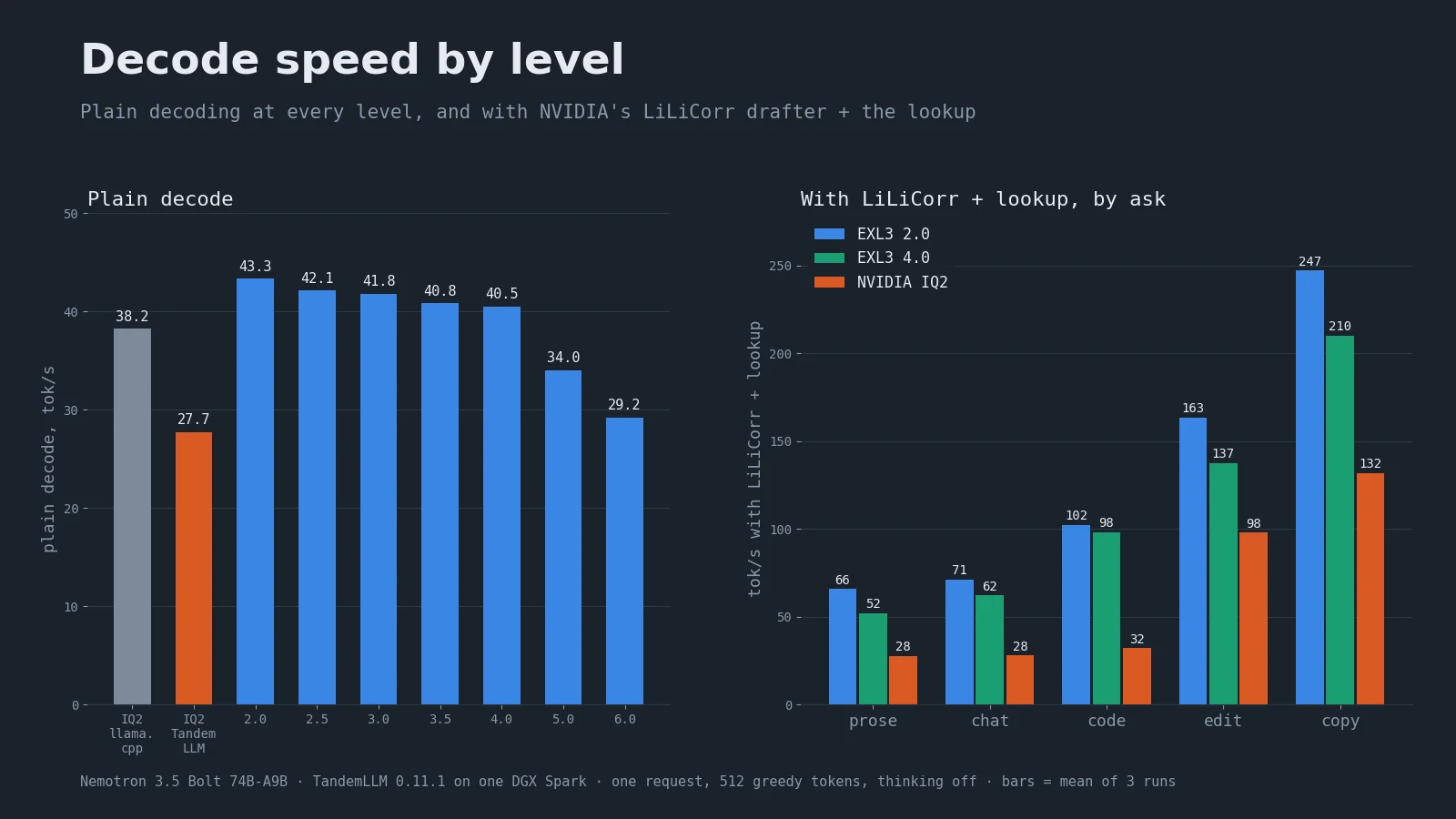
| Nemotron 3.5 Bolt 74B-A9Bour EXL3 2.0, LiLiCorr + lookup, 2026-10-16, 512 tokens, mean of 3 | 43.3 | 65.6 | 71.1 | 102.1 | 163.5 | 247.2 |
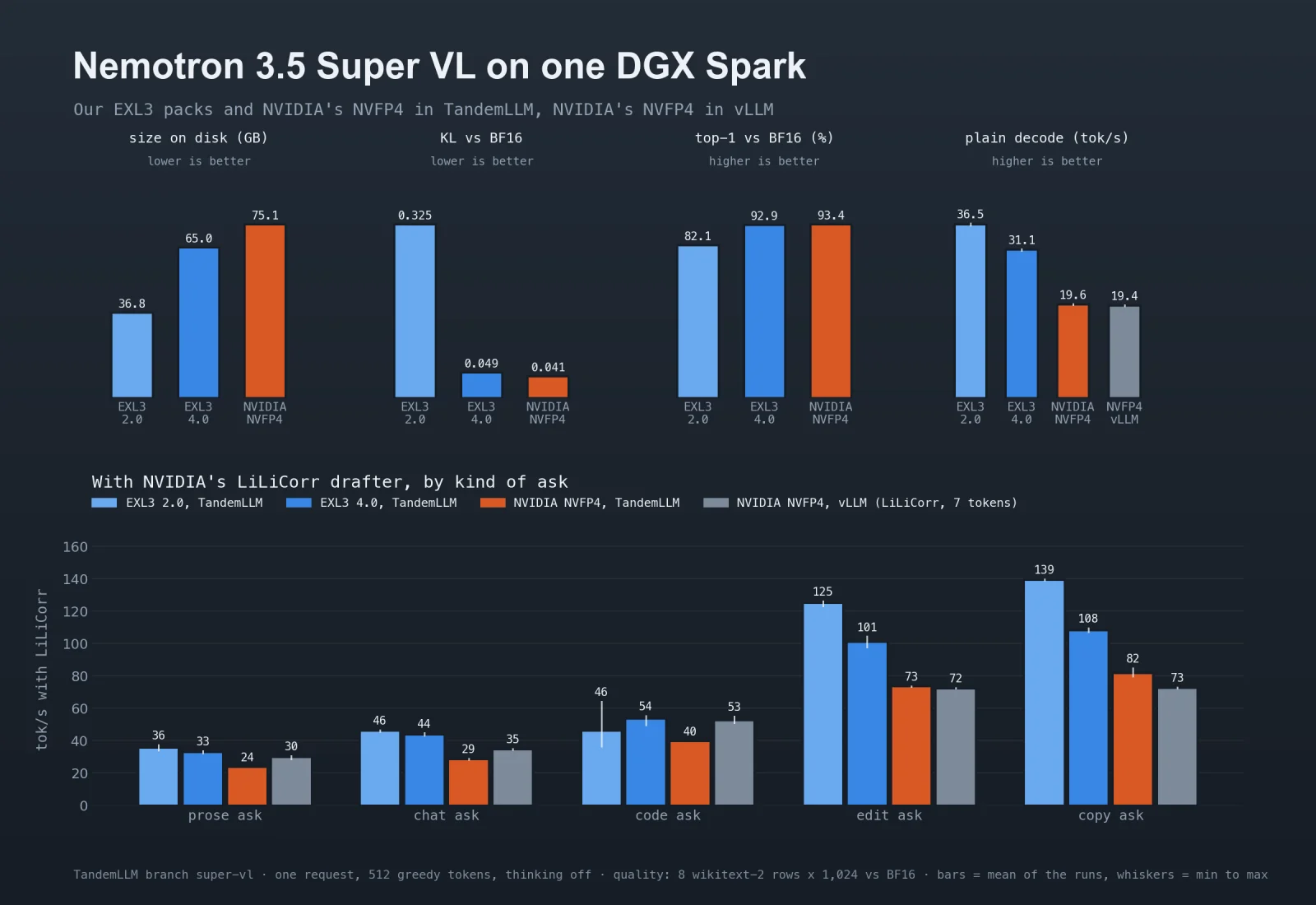
| Nemotron 3.5 Super VL 120B-A12Bour EXL3 4.0, LiLiCorr + lookup, 2026-10-16, 512 tokens, mean of 3 | 31.1 | 33.1 | 43.9 | 53.6 | 101.0 | 108.3 |
| Ornith-1.5-122Bour EXL3 4.0, MTP layer + lookup, 2026-10-20, 512 tokens, one run | 37.6 to 38.4 | 85.3 | 110.0 | 114.2 | 115.9 | 124.8 |
| Recursive Flintour EXL3 4.0, lookup, 2026-10-22, 512 tokens, one run | 128.2 to 136.6 | 135.4 | 134.0 | 139.8 | 142.3 | 480.0 |
Edits and copies run fastest because the lookup drafter can offer whole lines the model then accepts. Fresh prose gains least. On LFM2.5, already fast without help, the lookup costs up to 5 % in prose and chat. Flint has no draft layer, so the lookup drafts alone, and a copy ask runs at 480 tok/s against 128 plain. In every run above, the drafted text equals the plain run's text.
A long prompt sent twice
What is different
The model's own greedy text
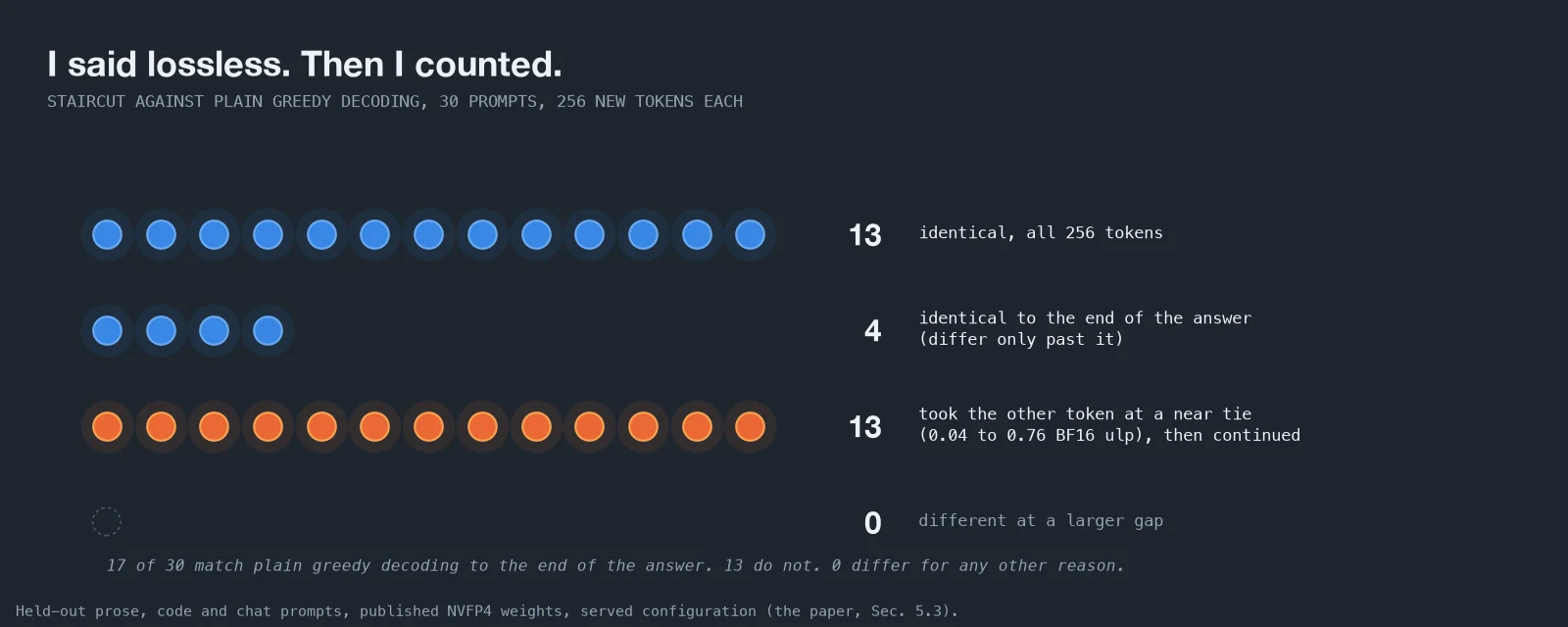
Under greedy decoding, TandemLLM writes the text its target model writes one token at a time, with one exception: at a near tie between the two best tokens, a batched check can round the other way. The drafters, the lookup store and the caches change how fast the text arrives, not what it says.
We counted how often the exception happens. On 30 held-out prompts with StairCut on the published NVFP4 set, 17 answers match plain greedy decoding to the end. 13 follow it up to a near tie of 0.04 to 0.76 ulp, take the other token and go on from there. None differs at a larger gap. On Flash-Next the check rows equal the one-token rows bit for bit, so there is no near-tie exception at all.
The exactness page states the promise and lists the checks that hold the engine to it.
StairCut sizes the guess tree every round
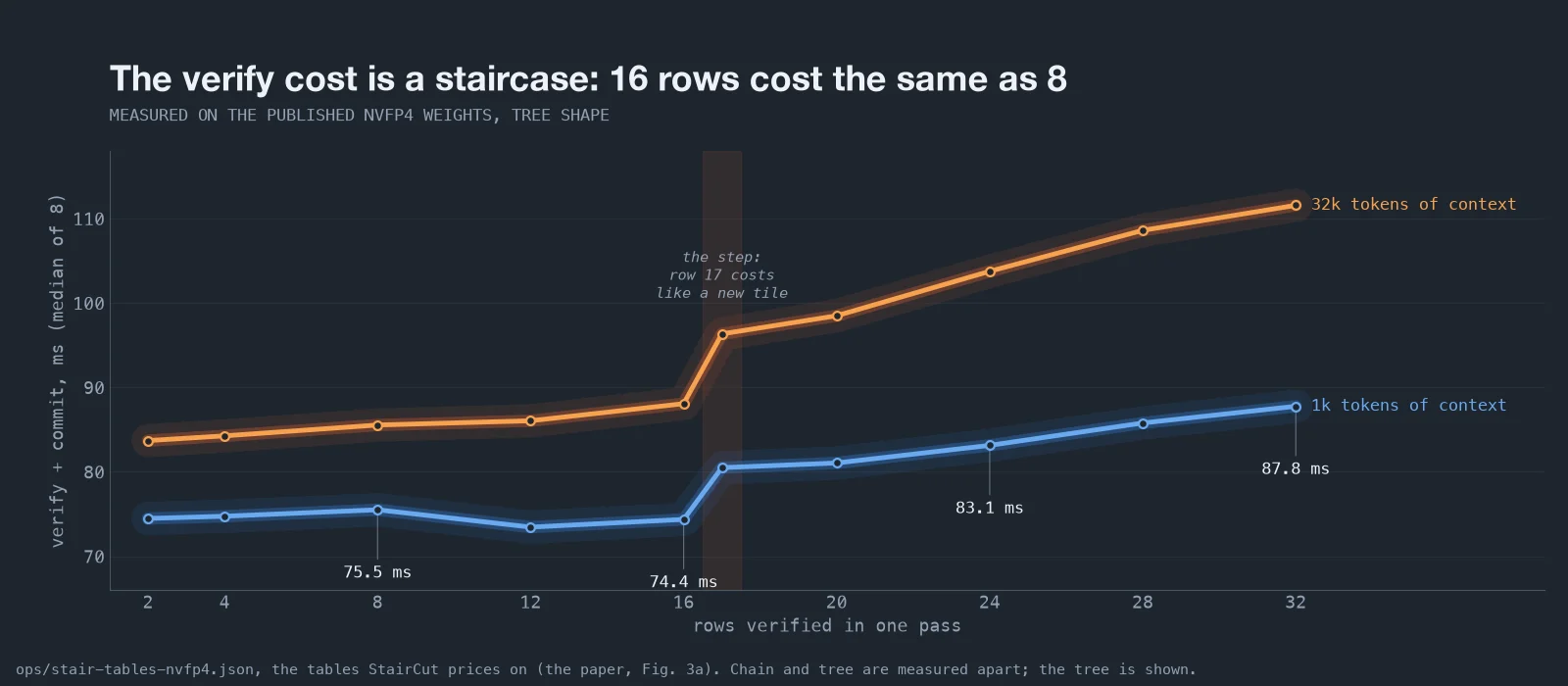
On this board a check of 16 rows costs the same as one of 8: 74.4 ms against 75.5 ms at 1k tokens of context. Row 17 opens a new tile in the 4-bit kernel, and the cost jumps. StairCut prices every round on that measured staircase and keeps the tree size with the most expected tokens per millisecond.
On a teacher-forced bench of 25 workloads, where every setup writes the same reference text, StairCut averages 90.45 tok/s against 81.95 for the fixed block 16 and 59.31 for the fixed block 8. The paper has the method and every run.
Our own EXL3 packs
We publish EXL3 packs of Qwen3.8-27B, LFM2.5, the Nemotron models, Ornith-1.5-122B and Flint, made with turboderp's exllamav3. Each card states its KL and top-1 against the BF16 checkpoint. Bolt's 2.0 pack and NVIDIA's own 2-bit GGUF are about the same download, 23.48 and 22.04 GB, and the pack's KL against BF16 is 0.170 against the GGUF's 0.259. Qwen3.8-Flash-Next runs from turboderp's own EXL3 packs: community quants, not ours.
Qwen3.8-27B also comes as an NVFP4 set, quantised once from Qwen's BF16 release with GPTQ. Against BF16 it costs +0.0221 nats on prose and +0.0426 on code.
Many models in tandem
The big models share one server, one set of caches, one way of drafting and one setup guide. Small models work beside the big one: drafters guess tokens, Wren (a 2B model) answers questions in the setup guide, and a decision model and a narrator can run next to the served model.
The dashboard can also stand in front of any OpenAI-compatible engine or cloud API, from vLLM and llama.cpp to OpenAI and DeepSeek, and keep one ledger of tokens and cost for every backend.