
Release notes, v0.13.0
TandemLLM 0.13.0 adds Ornith AI's Ornith-1.5-122B, an agentic and coding model on the Qwen3.5 mixture-of-experts layout, from our EXL3 pack at 4.0 bits a weight. It reads images, thinks before it answers and drafts with its own MTP layer. Every change is in CHANGELOG.md, and the PDF below is the manual.
Ornith-1.5-122B
- 0xBakeer/TandemLLM-Ornith-1.5-122B-EXL3-4.0 at 92f7483c, 64.6 GB, public. Every projection is at 4 bits, the head at 6, the MTP layer at 4 and the vision tower at 6.
- exllamav3 1.6.2 converted it from the BF16 checkpoint. Its 13 experts with all-zero fp16 weights needed a small patch to the quantizer, which is in the repository.
ops/use-profile.sh ornith-1.5-122b-exl3-4.0downloads it and starts it, and the Setup Guide lists it. A download needs no token. The base model, the pack and incoai's DFlash2 drafter for Ornith are in one collection.- The engine runs it on a new trunk,
engine/models/qwen3_5_moe: 36 Gated DeltaNet and 12 gated attention layers, 8 of 256 experts and a shared one a token, on the same EXL3 kernels as Flash-Next. It serves one request at a time, with a window up to 262,144 tokens. - The profile drafts with the MTP layer and the lookup. After a round where StairCut drafted nothing, the engine takes 1, 2, 4, then 8 plain steps before it tries again.
QSE_ORN_HEAD=dflash2switches to the DFlash2 drafter.
Measured on one DGX Spark on 2026-10-20, a fresh server for each row, greedy, thinking off, 512 tokens, one run each. The last column is a 2,048-token answer that writes a whole HTML game:
| tok/s | prose | code | chat | edit | copy | 2,048-token game |
|---|---|---|---|---|---|---|
| plain | 37.6 | 38.4 | 37.8 | 38.0 | 38.1 | 37.2 |
| MTP layer + lookup (default) | 85.3 | 114.2 | 110.0 | 115.9 | 124.8 | 103.3 |
| DFlash2 + lookup | 67.3 | 91.7 | 92.2 | 106.9 | 122.8 | 96.8 |
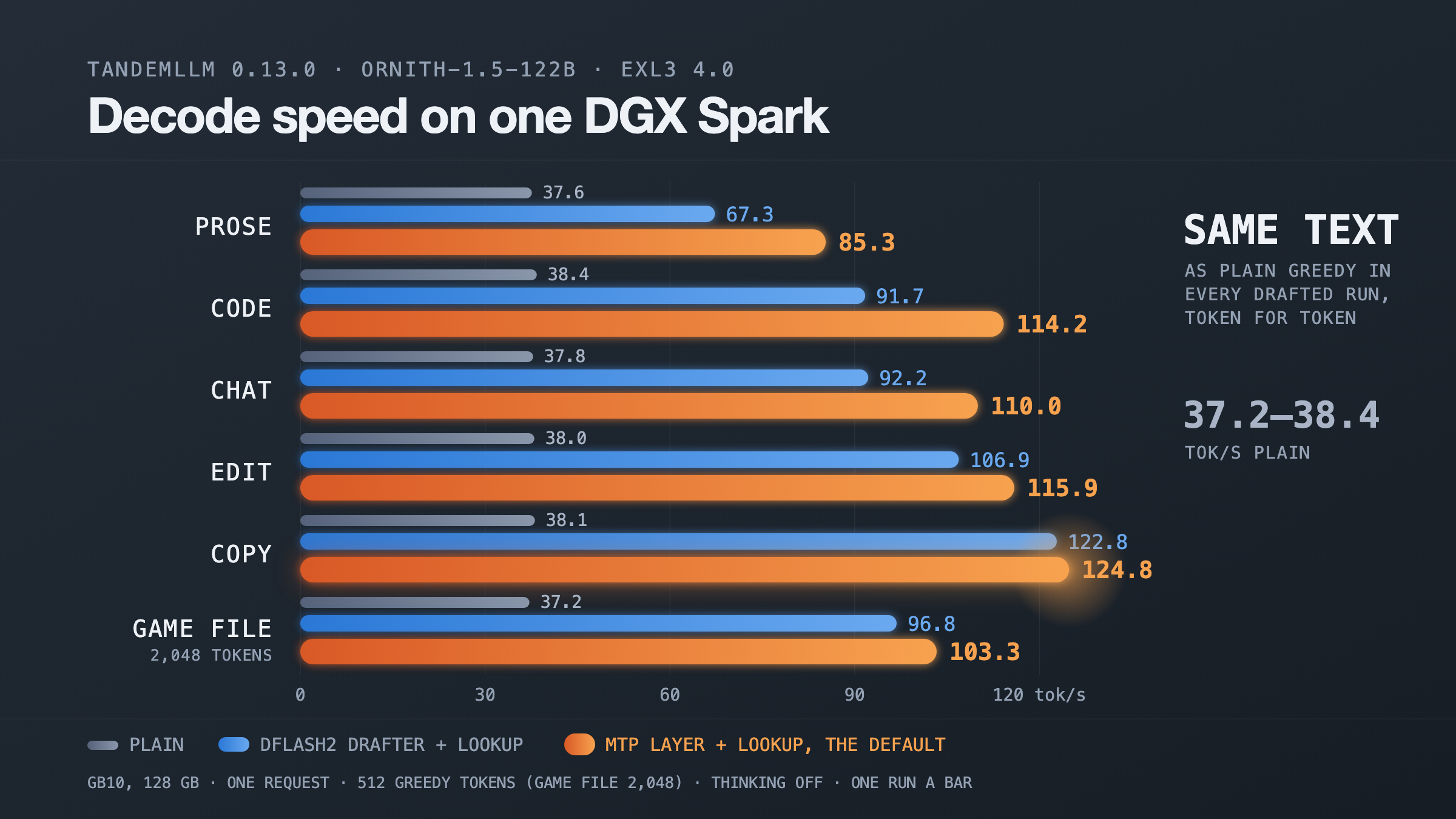
Every drafted text is the plain run's. A start loads the pack in 65 s, and the weights take 61.16 GiB with the MTP layer.
Against the BF16 checkpoint's logits, on 8 wikitext rows of 1,024 tokens, the engine gets KL 0.139 and top-1 86.2 %. exllamav3's own forward of the pack gets KL 0.136 on the same rows. Against that forward on the same pack, the engine's top token agrees at 498 of 512 positions, so the two are close but not equal. Of the 14 differences, 9 have a margin under 0.5 logits and one a margin over 4. The cause is not tested.
measurements/0.13.0-summary.json has the runs. Requests at once, prompt reading speed, images and repeat runs were not measured.
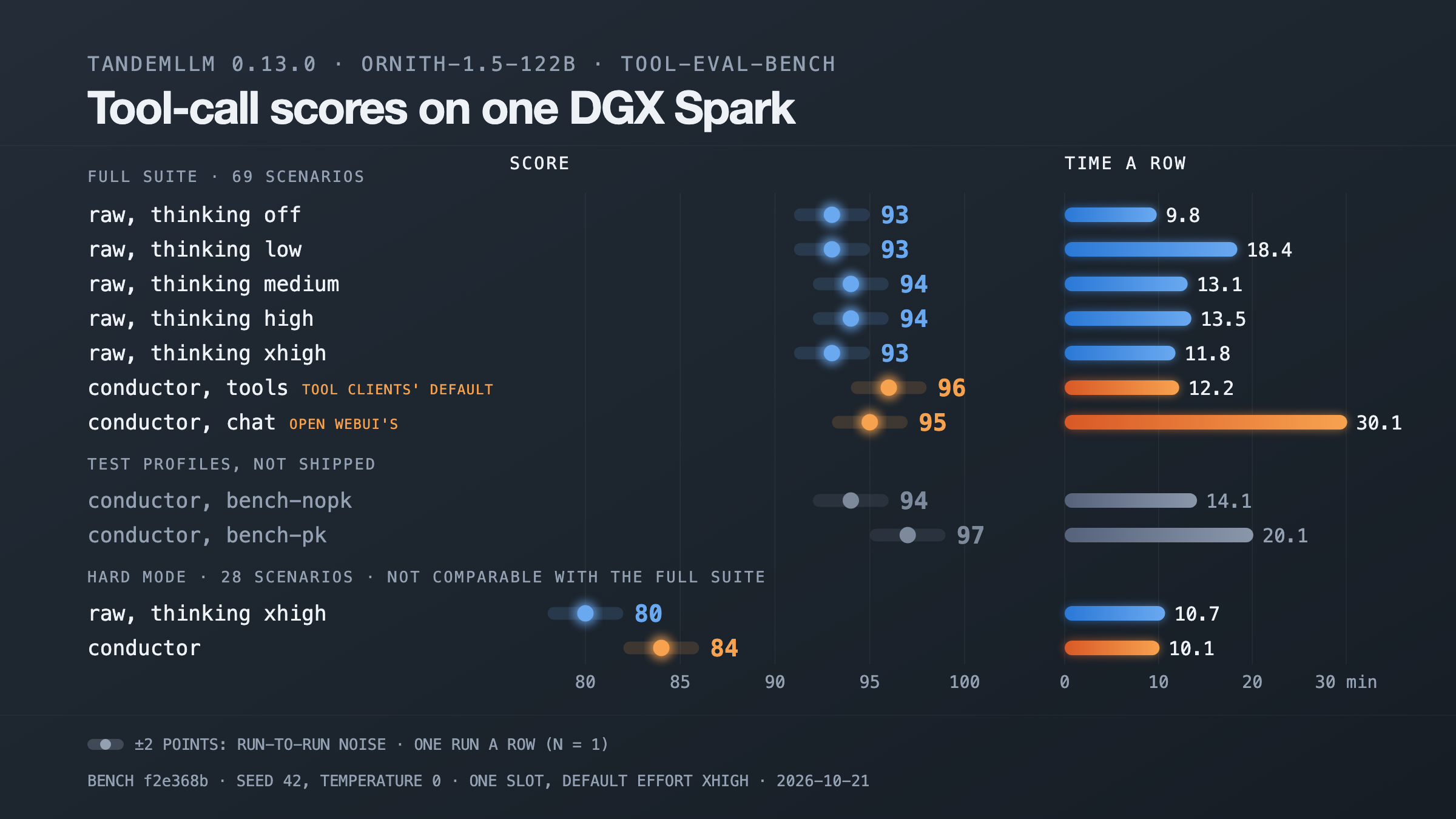
On tool-eval-bench, one run a row on this release, Ornith scored:
| row | score | time |
|---|---|---|
| raw, thinking off | 93 | 9.8 min |
raw, low / medium / high / xhigh |
93 / 94 / 94 / 93 | 18.4 / 13.1 / 13.5 / 11.8 min |
conductor, tools |
96 | 12.2 min |
conductor, chat |
95 | 30.1 min |
| hard mode, raw / conductor | 80 / 84 | 10.7 / 10.1 min |
docs/tool-eval-bench.md has every row, the misses and the flags.
Other changes
- The response cache keys on the effort level a request resolved to (SRV-645). A raw
xhightool-eval-bench run had replayed 190 answers of thehighrun before it. tools/teb_batch.shandtools/teb_summary.pyrun tool-eval-bench rows one at a time and keep what each row ran under (OPS-209).- A package whose result an offered tool delivers can stay out of the turn (SRV-615). It ships in shadow: it logs what it would keep out and changes no prompt.
- In the Chat tab,
grepgiven one file's path searches that file (SRV-649), andread_filereaches every line of a file over 4 MiB (SRV-651). tests/test_grammar.pypasses every run (SRV-647).- Ornith's caches have room (SRV-655). At the first ceiling of 74 GiB every end anchor and store snapshot was refused; the limits are now 86 and 90 GiB with a 2 GiB pin, and a store decline names the memory policy and its figures.
- When the end alignment fails on a rewritten tool call, the engine serves the part it aligned and resumes there (SRV-657). On Ornith one such turn had read 132,635 of 144,923 tokens again.
- In the Chat tab, writes and long commands stay whole in later requests until a fold point (SRV-659), and plan mode and a tool check that times out keep the request's head (SRV-663). A run stopped at its 100-call cap leaves the chat idle, and
render_pagekeeps a shader error's compiler lines (SRV-665). - Every test file runs its tests as a script, and a file that runs none fails (SRV-661).
tools/chat_trace.pyreplays a recorded chat throughchatdin seconds, andtools/prefix_check.pyreads what each request reads again (SRV-667).
The other models write the same text as in 0.12.2 and keep their saved conversations. The router kernel now takes up to 512 experts, which moved the fingerprints of Flash-Next, LFM2.5 and NemotronH; at 512 it runs as before, and their first start adopts 0.12.2's files.
Update
Run the installer again: bash ~/TandemLLM/src/install.sh --yes --ref v0.13.0, then tandem restart and tandem chat restart. On a box you installed with --setup, add --setup --force-setup and run ops/use-profile.sh with your profile after it. For Ornith, run ops/use-profile.sh ornith-1.5-122b-exl3-4.0; it downloads 64.6 GB and needs 93 GiB of free memory to start.
Files of the release
- tandemllm-manual-0.13.0.pdf (4509 KiB)